Forever Almost: The Strange Devotion We Pour Into Things That Never Got to Be
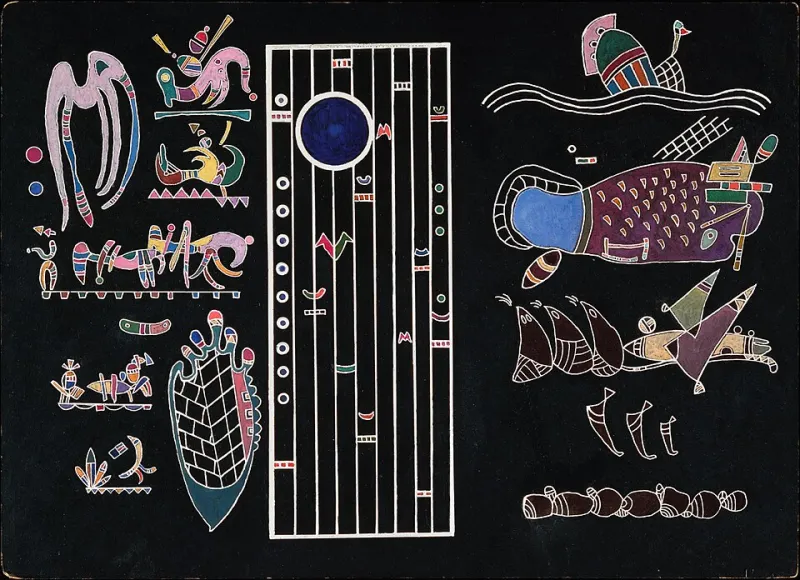
Photo: Wassily Kandinsky, Public domain, via Wikimedia Commons
Somewhere on a hard drive that no one living has ever touched, there are allegedly twenty-seven fully arranged songs from an album that was never released. The artist who made them died before finishing the cover art. Fans have spent years dissecting a single thirty-second clip that leaked on a forum in 2019, treating those fragments like scripture — pausing, rewinding, arguing about what the bass line means. The album doesn't exist. But the mythology around it absolutely does.
This is where we are now. The unfinished thing has eaten the finished thing's lunch.
The Gap Is the Point
There's a psychological concept called the Zeigarnik effect — the idea that our brains latch onto incomplete tasks more persistently than completed ones. Psychologists originally used it to explain why waiters remember unpaid tabs better than settled ones. But it maps onto creative culture in a way that feels almost uncomfortably precise.
When something is finished, it closes. You can love it, revisit it, let it become part of you — but it has edges. A boundary. An ending. An incomplete work doesn't have any of that. It stays open. And an open wound, culturally speaking, never really stops bleeding.
Drake's Jungle, Kanye's shelved Donda sessions that existed before the official album, Lauryn Hill's rumored follow-up to The Miseducation — these phantom projects have generated entire ecosystems of speculation, fan theory, and creative reimagining that dwarf the attention paid to plenty of records that actually came out. The absence isn't a flaw in the story. The absence is the story.
What We Do With the Silence
Here's what's interesting: fans don't just mourn unfinished work. They complete it. Constantly, obsessively, collaboratively.
Fan fiction communities have long filled the gaps in existing narratives, but there's a distinct subgenre now — call it completion culture — built entirely around artifacts that never crossed the finish line. Reddit threads that run to hundreds of pages reconstruct scrapped screenplays from production notes and leaked call sheets. Discord servers host listening parties for bootleg demos, with users annotating each track like scholars parsing a lost gospel. Someone out there has built a full alternate version of an abandoned video game using only what could be reverse-engineered from an unfinished beta.
The incompleteness doesn't frustrate these communities. It activates them. The gap is an invitation.
And honestly? The work they produce — the theories, the reconstructions, the fan-made completions — is often more creatively alive than a lot of polished, finished, professionally released content. There's something about the constraint of working from fragments that forces a kind of imaginative intensity that comfort and completion tend to dull.
The Romantic Mythology of the Almost
We've always had a soft spot for the tragic arc of potential cut short. Think of Keats dying at twenty-five, Schubert's Unfinished Symphony (which, it should be noted, is unfinished largely because he just... stopped and moved on, which somehow makes it more mysterious rather than less). American culture in particular has a deep romance with the idea of the artist who burned too bright, who left before the work was done.
But something has shifted. It's not just about premature death or tragic circumstance anymore. Plenty of the most mythologized abandoned projects belong to living artists who simply moved on, changed direction, or had their work shelved by circumstance. The mythology doesn't require death. It just requires incompleteness.
Frank Ocean's Boys Don't Cry — the album that was supposed to arrive before Blonde — became one of the most discussed non-releases in recent music history. Terrence Malick's long-gestating, partially-shot projects generate film discourse even in their unfinished state. The abandoned novel that exists only in a dead author's letters becomes required reading in a way the actual published work sometimes doesn't.
There's a cruelty to it, if you think about it too hard. Completion gets punished with finitude. Incompleteness gets rewarded with immortality.
Why Now, Specifically
It would be easy to frame this as a timeless human tendency — and it is, partly. But there's something about right now that's accelerating it.
We live in a media environment defined by leaks, previews, trailers-for-trailers, and early access everything. The boundary between process and product has basically dissolved. We follow artists on social media while they're mid-creation. We watch studio sessions on YouTube. We hear about albums before a single note is recorded. By the time something actually releases, we've often already been living with a version of it in our heads for years — and that imagined version is intimate in a way the final product can't always match.
The finished album has to compete with the album we built in our imagination during the waiting. And sometimes it loses.
There's also something generational here. A lot of people under forty grew up in an internet culture that was itself defined by incompleteness — websites that went dark, forums that disappeared, games that were never patched, communities that collapsed mid-conversation. The unfinished isn't alien. It's the native texture of the digital world we actually inhabited.
The Ethics of the Obsession
It's worth sitting with the uncomfortable part of this, too. Not all abandoned work is abandoned by choice. Sometimes artists leave things unfinished because the industry failed them, because mental health crises intervened, because the resources dried up. Treating those fragments as sacred artifacts can sometimes mean aestheticizing someone's worst moment — the place where they ran out of road.
The fan who builds an elaborate theory about what a scrapped album meant might be doing something genuinely beautiful. They might also be projecting meaning onto a wound that the artist never wanted anyone to see.
There's a version of completion culture that honors the incomplete work by taking it seriously. And there's a version that just feeds on the mythology without ever asking whether the person who made the thing actually wanted it found.
The Beauty in the Broken Sentence
Still. There's something real here that's worth not dismissing.
The unfinished thing holds a kind of tension that finished things can't. It asks something of you. It won't let you be passive. You have to bring yourself to it — your imagination, your grief, your speculation, your need. In a media landscape that increasingly asks nothing of its audience beyond passive consumption, the incomplete artifact is almost radical in its demands.
It says: I can't give you everything. What are you going to do with what I left?
And we answer. Obsessively, creatively, sometimes embarrassingly, often beautifully. We fill the silence with ourselves. Which might be, in the end, exactly what all art is actually trying to do anyway — just usually with more notes in the margin.