Nowhere Feels Like Home: The Strange, Sad, Beautiful Internet Obsession with Places That Don't Want You
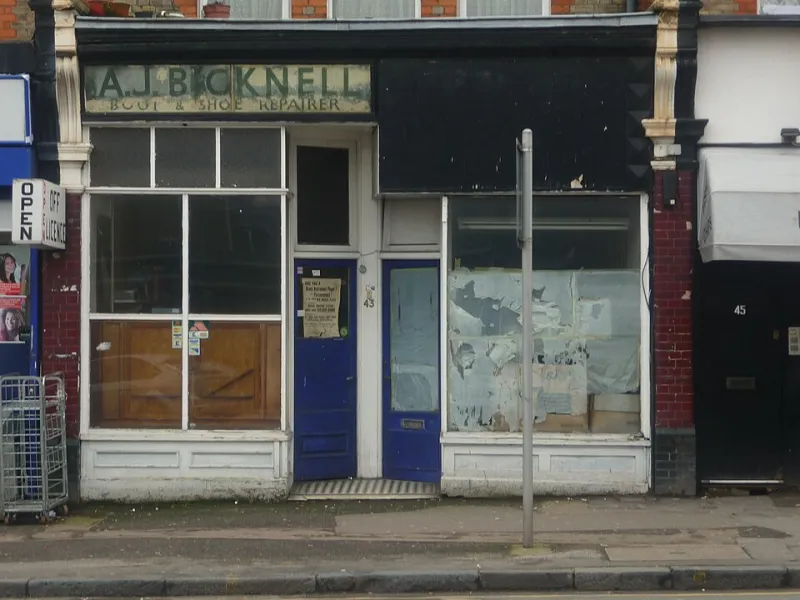
Photo: Julian Osley, CC BY-SA 2.0, via Wikimedia Commons
Picture this: a swimming pool, drained completely, lit by a single overhead light that hums with that specific frequency that makes your teeth feel weird. The tile is that shade of aqua that belongs entirely to the late '80s. There's no one there. There's never anyone there. And somehow — somehow — looking at it feels like remembering something that never actually happened to you.
Welcome to liminal space culture. Population: increasingly, everyone.
What Even Is a Liminal Space?
The term comes from the Latin limen, meaning threshold. Anthropologists originally used it to describe transitional states in ritual — the in-between moments when you're no longer what you were but not yet what you're becoming. Scholars like Victor Turner wrote about liminality as a kind of social suspension, a space outside normal structure.
Somewhere between academic theory and TikTok, the concept got beautifully, productively mangled. In internet vernacular, a liminal space is any physical location that feels like a threshold — a place designed for passing through, now emptied of its purpose. Airport terminals at 4am. School hallways during summer. The back rooms of department stores. Suburban cul-de-sacs under overcast skies. These images circulate endlessly across Reddit (r/LiminalSpace has over a million members), TikTok, Pinterest, and Discord servers dedicated to cataloguing them with the devotion of naturalists documenting rare species.
The visual grammar is consistent: fluorescent lighting, institutional carpet patterns, the particular geometry of spaces built for crowds that contain none. And the emotional response they provoke is weirdly universal — a cocktail of nostalgia, unease, and something almost like grief for a moment you can't quite place.
The Backrooms and the Birth of a Mythology
No conversation about liminal space culture is complete without the Backrooms — the piece of internet folklore that arguably crystallized the whole movement into something mythological.
It started with a single 4chan post in 2019: a grainy photo of an empty office space, yellow-tinged fluorescent lighting, industrial carpeting in that nauseating pattern, no doors, no windows, no end. The caption: "If you're not careful and you noclip out of reality in the wrong areas, you'll end up in the Backrooms."
What followed was one of the most organic acts of collaborative world-building the internet has ever produced. Users began adding to the mythology — floors, levels, entities, rules for survival. The Backrooms became a full cosmology, a shared nightmare architecture. YouTube creators built short films inside it. A feature-length Backrooms movie from a teenage filmmaker went viral with millions of views. The New York Times wrote about it. And through all of that, the core image — the empty, wrongly-lit, infinite nowhere — retained its power.
That power isn't accidental.
Nostalgia for a Time You Didn't Experience
Here's the thing about the aesthetic that makes it genuinely interesting from a cultural standpoint: most of the spaces that define liminal culture are relics of the '80s and '90s. That's not the childhood of Gen Z — it's the childhood of their parents, or older siblings, or nobody they know personally. Yet the emotional resonance is immediate and intense.
Creators who've built followings around this content talk about it constantly. Mara, a 22-year-old content creator from Ohio who runs a liminal space account with over 400,000 followers across platforms, described it to us as "nostalgia for a feeling rather than a memory. Like your brain recognizes the emotional texture of a place even if you've never been there. Those spaces feel like the edge of something you almost remember."
Psychologists have a term adjacent to this — anemoia, defined informally as nostalgia for a time you've never lived through. It's not officially in the DSM, but it's all over the internet, and it maps almost perfectly onto what people describe feeling when they look at a photo of an empty Kmart circa 1993.
What's Gen Z nostalgic for, exactly, when they never experienced those spaces in their prime? Possibly for a version of public life that felt more spacious, more anonymous, less surveilled. Or for the specific texture of boredom before smartphones — the particular quality of time that moved differently in a mall food court or a public pool. Or maybe just for somewhere that doesn't ask anything of you.
The Digital Art Movement That Grew From the Void
Liminal aesthetics have generated a genuinely significant body of digital art. Artists working in 3D rendering, photography, and graphic design have built entire practices around these spaces — constructing impossible architectures, photographing real abandoned locations, or generating dreamlike hybrids of both.
The work ranges from the quietly melancholy to the actively unsettling. Some of it engages directly with American decline narratives — the dead mall as cultural artifact, the shuttered suburban infrastructure as evidence of economic promises that didn't land. There's something politically resonant in the obsession, even when it's not consciously political. These are the spaces that were supposed to represent American abundance and community, now drained and humming with absence.
Other artists push toward pure surrealism — spaces that couldn't exist but feel architecturally inevitable, like your brain already knew the blueprint. This is where the digital tools get interesting: AI image generation has become a significant part of the liminal art toolkit, producing spaces that feel like recovered memories of places that were never built.
Why Now? Why This?
It's worth asking why this particular aesthetic has captured this particular generation so completely. The easy answer involves pandemic isolation, climate anxiety, and the general vibe of living through a historical period that feels like a long hallway with no visible exit. Those things are real.
But there's something else, too. Gen Z is the first generation to have grown up entirely inside digital space — to have a native understanding of the internet as a place, with its own geography, its own abandoned rooms, its own infrastructure that outlasts its purpose. The liminal space aesthetic maps onto that experience almost literally. Every dead link is a drained pool. Every defunct forum is a closed-off wing of the mall.
The fascination with these spaces isn't nihilistic, despite how it might read from the outside. It's actually a form of attention — a refusal to look away from the places and moments that mainstream culture would rather demolish and replace. There's care in cataloguing the forgotten. There's something almost tender in the way these communities document nowhere.
And if nowhere feels a little like home right now, maybe that's okay. Maybe that's honest. Maybe that's the most accurate map anyone's drawn of where we actually are.