Ten Thousand Members, Zero Witnesses: The Strange Emptiness Inside the Internet's Busiest Rooms

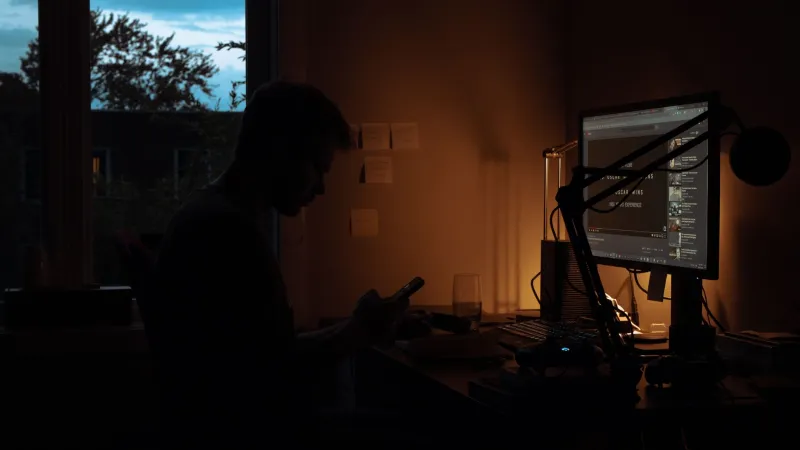
Photo by Photo by Faraaz Zuberi on Unsplash on Unsplash
There's a Discord server for a mid-sized American indie game that has just under fourteen thousand members. The announcement channel gets pinged maybe twice a month. The general chat moves at roughly the speed of continental drift—a message every few hours, sometimes none for days. The fan art channel has posts from 2021 that nobody ever reacted to. And yet, every single day, new people join. They lurk for a while. Then they vanish into the silence.
This is not unusual. This is basically the template.
The Number That Means Nothing
We've built an entire architecture of legitimacy around member counts. A Discord with ten thousand people feels more real, more worth joining, than one with forty. A subreddit with half a million subscribers carries cultural weight that a tight hundred-person forum never could. We use these numbers as proxies for vitality, for relevance, for the thing we actually want—which is the feeling that other people are there, that we're not just shouting into a void.
But the math doesn't work out. It never really did.
Communication researchers have been circling this problem for decades, long before Discord existed. Dunbar's number—the idea that humans can maintain meaningful relationships with roughly 150 people at most—gets cited a lot in these conversations, sometimes reductively. But the underlying point holds: there's a ceiling on how much genuine social texture a person can process. Scale past it, and something changes. The room stops feeling like a room and starts feeling like a lobby. Everyone is technically present. Nobody is actually there.
What Active Looks Like vs. What Active Feels Like
Platforms are very good at making emptiness look like activity. Automated welcome bots fire off cheerful messages when you join. Pinned posts from two years ago sit at the top of channels, giving the impression of a rich history. Activity logs show thousands of messages sent over the server's lifetime—but when you scroll back through general chat, you find the same five people talking to each other in loops, a tiny core keeping the lights on while the rest of the membership exists as a number on a dashboard.
Slack workspaces do this differently but achieve the same effect. Corporate and community Slacks alike have channels that haven't seen a real human message in months, status indicators showing dozens of people "online" who are very much not paying attention, and the particular horror of typing something into a channel and watching the "seen by 47 people" counter tick up while zero responses come in. Seen. Not witnessed. Not heard. Just processed by someone's peripheral vision before they scrolled away.
This is the loneliness factory in operation: an environment engineered to look like connection while systematically failing to produce it.
The Paradox Nobody Wants to Say Out Loud
Here's the uncomfortable thing. A lot of these massive, empty communities were built by people who genuinely wanted connection—and who chose scale as their strategy for getting it. The logic makes intuitive sense: more people means more chances to find your people. Cast a wider net. Build something big enough that the right strangers will wander in.
But size changes the social physics of a place in ways that are hard to reverse. When a community is small, posting feels like talking. When it's large, posting feels like performing—or, worse, like dropping a note into a suggestion box that nobody checks. The intimacy that makes connection possible requires a certain density of mutual attention, and that density gets diluted fast. A hundred-person server where sixty people showed up to talk about the same weird thing has more connective tissue than a ten-thousand-person server built around a broad interest that nobody feels strongly enough about to actually start a conversation.
Smaller communities have known this forever. The forums that survived the social media consolidation of the 2010s—the ones still running on phpBB or Discourse or whatever ancient infrastructure their founders set up—tend to be places where the membership cap is a feature, not a bug. Where moderators actively discourage growth past a certain point. Where new members get actually greeted by actual humans who remember joining themselves.
What We're Actually Hungry For
There's a reason people keep joining these hollow servers even after experiencing the emptiness firsthand. The hunger is real. The need for a place that feels like yours, where the references land and the in-jokes accumulate and someone remembers what you said last week—that's not going away. It's one of the most persistently human things about being online.
What's broken is the delivery mechanism. We've handed the job of building community to platforms whose business incentives are entirely aligned with the appearance of community rather than its actual substance. Member count is a metric that shows up in pitch decks and press releases. The feeling of being genuinely known by three people in a server of twelve doesn't have a dashboard widget.
Some corners of the internet are pushing back on this, quietly. Private group chats that function more like digital living rooms than public squares. Invite-only communities that enforce intimacy through scarcity. The resurgence of email newsletters and their reply cultures, where the audience is small enough that the creator actually responds. These aren't scalable solutions in any conventional sense—and that might be exactly the point.
The Ghost Metric
The cruelest part of the loneliness factory is that the people inside it often can't tell it's happening. You join a server, you look at the member count, you feel the comfort of numbers. You lurk for a while because it seems like there's already a conversation happening that you'd be interrupting. And then you go quiet, the same way everyone else went quiet, and you become part of the statistic that makes the next person feel like they're walking into a room full of people.
You're all there together, alone.
The internet built tools for broadcasting and called them community. It built spaces for audiences and called them gathering places. And we showed up, because we wanted what the names promised—and then we learned to perform presence in rooms where nobody was really watching, because at least the performance felt like something.
Fourteen thousand members. One fan art post from 2021 with no reactions.
Somebody made that. Somebody thought it was worth sharing. And then they waited, in a room full of thousands of people, for someone to notice.